
Madison County Projected Release Meaning
A projected date is a calculation based on information available at a point in time. An actual release date and time document when physical custody ended or changed. These can differ. The court may issue an order before staff finish release processing, or another agency may assume custody. A transfer from Tri-County Regional Jail to ODRC ends the jail stay but is not release to the community.
Sentence type is crucial. A pretrial detainee has not begun a final sentence merely because a booking exists. Bond, dismissal, plea, trial, or a later sentencing order can determine what happens next. For a sentenced person, the calculation can involve the effective sentence date, concurrent or consecutive terms, mandatory specifications, certified jail-time credit, earned credit, and any lawful release mechanism.
The difference matters in Madison County because the former county jail is closed. Local detainees are held at Tri-County, while Madison Correctional Institution and London Correctional Institution are ODRC prisons located in the county. The facility name alone does not identify the right date source.
Find Madison County Projected Release
Begin by identifying whether the case is local, state, federal, or immigration-related. The Madison County released-inmate search maps those custody systems in full. For release-date work, the most useful identifiers are the full name, date of birth, booking or offender number, sentencing court, docket number, and admission date.
- Check the latest signed court entry. Determine whether the person is pretrial, serving a local jail sentence, ordered to ODRC, or subject to another authority.
- For an ODRC prisoner, search the Ohio offender database. Use the offender number with its letter prefix when possible.
- Match the record by birth date, offense, committing county, and docket. County of commitment means the sentencing county, not the prison location or current home.
- Read the full date label and nearby status. Compare the combined date with sentence, jail-time credit, parole, and supervision fields.
- For a Tri-County jail sentence, ask the jail and sentencing court for the computed date and written basis. No public local calculator was found.
- Recheck close to release. Ask ODRC Central Records about a state-data conflict and the sentencing court about a conflicting journal or credit entry.
Federal sentences belong in the BOP locator, while ICE custody uses its own system. Neither supplies a Tri-County or ODRC date. A BOP future date is projected, and an ICE result is a custody-status record rather than a criminal sentence calculator.
Note: A person missing from Tri-County's current roster may have transferred, so absence alone cannot establish any projected release date.
Madison County ODRC Date Field
ODRC uses the combined label Expected Release Date/Parole Eligibility Date. Preserve all of those words. The agency defines the field as either a projected release date or a date pending parole consideration. A definite sentence may produce a projection. An indeterminate or life sentence may instead show when Parole Board consideration becomes possible. Eligibility does not guarantee release.
Other labels can add context. POA Date means the earliest date of release on APA supervision, or parole on or after. PRD means projected release date. An earliest possible transfer date concerns transitional control. A supervision start date can confirm that prison confinement ended, but it does not establish final discharge from all state authority.
The official ODRC release-date definitions show the exact wording used in public results.
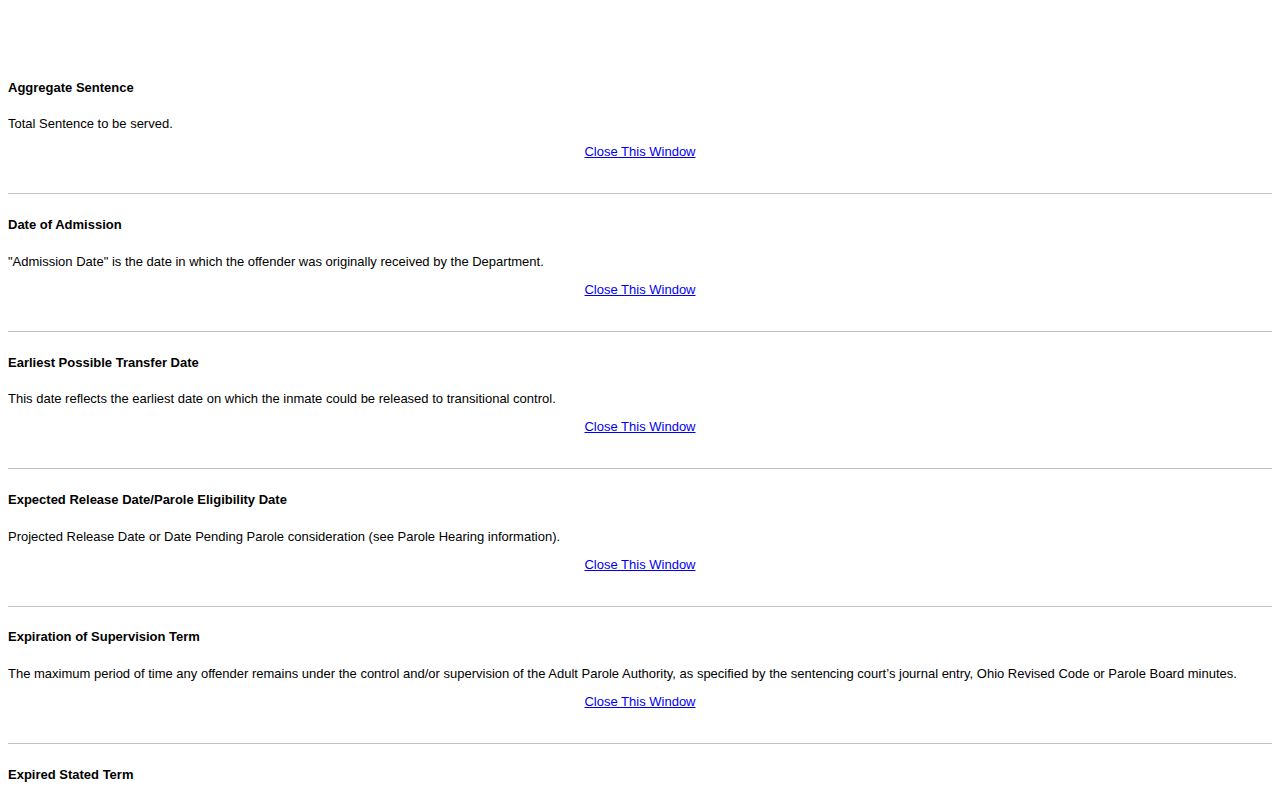
The definitions make clear why a reader must examine sentence type and status before describing the displayed value as an expected exit.
Madison County Prison Earned Credit
Ohio prison credit depends on the statute and sentence. Current ORC 2967.194 applies to qualifying confinement that began on or after April 4, 2024. It provisionally awards one or five days for each completed month of productive participation. The statute also includes a possible one-time completion credit and, in specified cases, up to 90 days or ten percent of the stated term, whichever is less, for qualifying achievements.
Most participation and completion credits within the capped portion may not exceed fifteen percent of the stated prison term. That does not create a universal rule that every Ohio prisoner serves exactly eighty-five percent. The rough percentage applies only to the eligible capped class. Mandatory or nonreducible terms and listed serious or sex offenses can be excluded or treated differently. Credits can also be denied or withdrawn after a rule violation and administrative review.
Older-law sentences, SB 201 indefinite sentences, judicial release, transitional control, risk-reduction sentences, program credits outside that cap, and certified jail-time credit can yield different outcomes. ODRC's public definitions contain some legacy one-day-per-month wording, but the current statute controls a current calculation. A reliable Madison County projected release date therefore comes from the operative ODRC record, not a blanket percentage.
Jail-time credit is separate. Under ORC 2967.191, qualifying prior confinement can reduce a prison term under the statute's terms. Read the sentencing entry and ODRC calculation together. If the figures conflict, the court and Central Records should correct the source records rather than a reader recomputing the term from a partial docket.
Madison County Jail Work Credit
Local jail calculations follow a different rule. ORC 2947.151 permits a sheriff to grant work-based sentence reductions only with written concurrence from the sentencing judge or magistrate. The statute uses tiered rates: up to three days per thirty days for sentences of ninety days or less, four days for terms over ninety days through six months, and five days for longer terms.
This credit is discretionary. It is not automatic for every person held at Tri-County Regional Jail, and the research found no public Tri-County policy that supports a one-size calculation. The research also found no official weekend or holiday rule that moves a scheduled Sunday discharge to Friday. Families should not make travel plans from that assumption.
Ask the jail and sentencing court for the current computed date, awarded credit, and written authority. A local court journal may record the sentence and jail-time credit, while the jail documents the physical release event. These records answer different questions and should be compared, not merged.
The official statute image below comes from the successful page-matched manifest capture. The Ohio county-jail work-credit law is the source for the judicial-concurrence requirement.
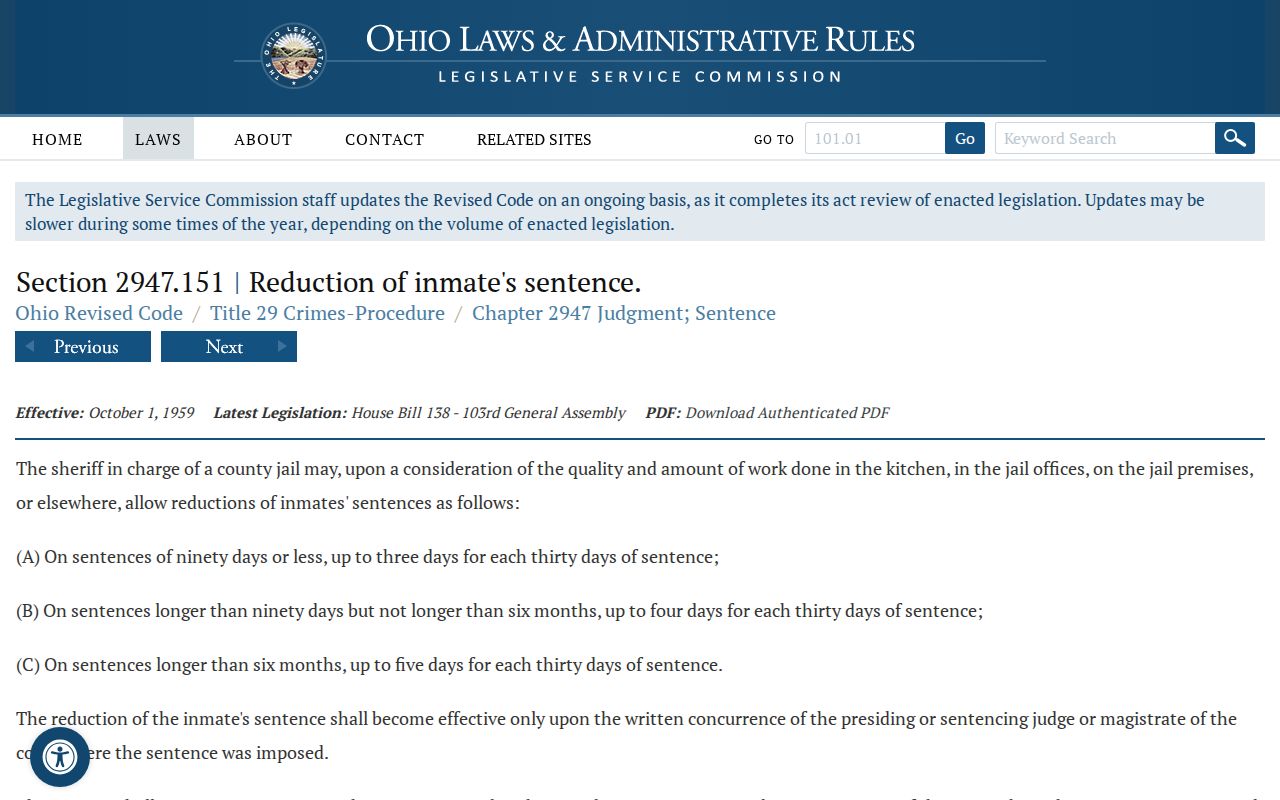
The statutory text supports a case-specific calculation and rules out an unsupported automatic-credit promise.
Note: No official Madison County source establishes automatic jail credit or a standard early release for weekends and holidays.
Why Madison County Release Dates Change
A projection is only as stable as the inputs behind it. Some changes come from a corrected record. Others come from a new court or agency decision. The public result should be dated when saved, and any later check should use the same offender number and source.
| Factor | Possible effect | Source to verify |
|---|---|---|
| Corrected jail-time credit | Moves the calculated term after qualifying prior confinement is fixed | Sentencing court and ODRC Central Records |
| Earned credit award or withdrawal | May advance or delay a qualifying prison projection | ODRC sentence calculation |
| Program completion | May add a credit or activate another lawful release route | ODRC record and governing statute |
| Sentence modification or appeal | Can change the controlling term or order | Signed court journal entry |
| Parole decision | Eligibility may lead to release, continuance, or another review | Individual ODRC Parole Board fields |
| Detainer or transfer | May prevent community release even when one custody term ends | Holding and receiving agencies |
| Disciplinary or additional-term action | Can move release for an applicable sentence | ODRC administrative record |
A court filing is not always a final order. A judicial-release motion, for example, does not change custody unless the sentencing court grants it. Likewise, a future parole-review month is not the date someone will leave prison. Read the signed order or official result.
Several dates in Madison County records describe different stages. An arrest can occur before booking. A court may sign an order before a jail completes discharge steps. The effective sentence date is a calculation point and may differ from the prison admission date. ODRC jail-time credit can move a projected date, while a supervision start date shows a later shift from confinement into APA control. A Parole Board review month marks review timing, not a promised exit. Keep each official label beside the date when saving or comparing records. If two agencies show different values, record both check times and ask the office responsible for that field to resolve the conflict.
A missing value also needs restraint. A blank combined date does not mean zero time remains, and a non-result does not prove that no sentence exists. The offender number may be formatted incorrectly, intake data may still be loading, the name may differ, or the person may never have entered ODRC custody. Tri-County roster absence has similar limits. It can reflect release, transfer, spelling, or processing lag. A sound Madison County projected release check therefore pairs the correct custody record with the latest signed court entry and uses more than a name or photograph to match the person.
For an indeterminate sentence, the distinction between eligibility and release is especially sharp. ORC 2967.13 sets parole eligibility rules for applicable sentences, but reaching an eligibility date permits consideration only. The Board may act under the governing law and individual record. Judicial release follows a different path under a sentencing court. Neither event should be inferred from the combined ODRC date field alone.
Confirm Madison County Release Timing
Recheck the responsible source near the expected event. For ODRC, open the individual record and note its status, the full combined date label, any POA or PRD field, supervision start, and Parole Board details. Questions about displayed state data go to ODRC Central Records at P.O. Box 430, Columbus, OH 43216.
For a local Madison County case, call Tri-County at 937-834-5000 and review the latest signed entry from Common Pleas or Municipal Court. Ask for an existing calculation or release record instead of asking staff to predict a new date. If another agency has a detainer, confirm whether the event will be community release or a custody handoff.
Ohio VINE can add a custody-change alert for a matching participating record. The detailed Madison County VINELink inmate search explains source matching and notifications. An alert is useful corroboration, but the jail, ODRC, or court remains the source for a disputed date.
Can a supervision start date replace an actual release time? No. It strongly supports a transition out of state confinement, but only the custodial release record establishes the actual event and time.