
Federal Locator Release Scope
No federal prison was identified as a Madison County local-release facility. The Federal Bureau of Prisons locator is a contingency channel for a person whose case or sentence is federal. It does not establish release from Tri-County Regional Jail, Madison Correctional Institution, or London Correctional Institution. Those local and Ohio systems keep their own records.
A BOP result can remain available after a federal prisoner leaves custody. A past release date with no facility location, a location shown as `RELEASED`, or wording such as `Not in BOP custody` supports departure from BOP custody under the displayed record. It does not establish that federal supervised release ended. It also cannot exclude a new state, local, or immigration custody event.
Search Federal Inmate Release Records
The BOP Inmate Locator offers two main search routes. An identifier search accepts a BOP register number, DCDC number, FBI number, or INS number. A name search uses first, middle, and last name, with optional race, age, and sex filters. An identifier is usually the safer key because name spellings and shared names can create false matches.
- Confirm the underlying federal case, judgment, or BOP connection before opening the locator.
- Search by BOP register number or another supported identifier when one is known.
- If searching by name, start with the exact legal name and add filters only as needed.
- Open the matching result and compare name, register number, age, race, sex, location, and release date.
- Keep the official wording and date. Do not convert `UNKNOWN`, a future date, or not-in-custody text into a claim the record does not make.
The successful manifest capture shows the official locator's identifier and name-search routes.
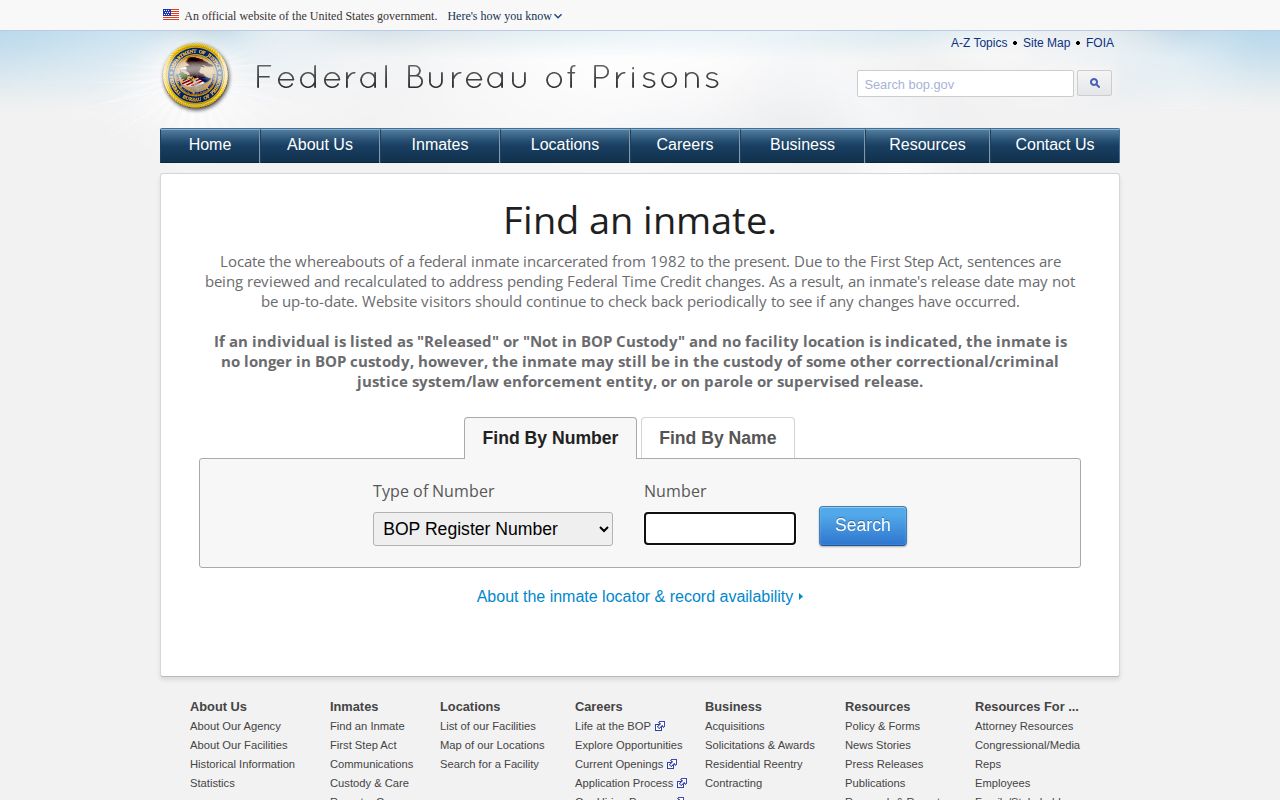
This search is appropriate for BOP history. It is not a substitute for a Madison County jail record, an ODRC state-prison record, or a federal court order.
Read Federal Locator Release Results
BOP states that a public result can include name, register number, age, race, sex, release date, and location. Each field has a narrow purpose. The location describes BOP placement or released wording within that system. The release date can be past or projected. `UNKNOWN` means the term has not been determined, not that release will never occur.
| Displayed field | Careful reading |
|---|---|
| Register number | Primary federal identifier used to distinguish a person. |
| Facility location | Current BOP placement when one is shown. |
| `RELEASED` or no facility | The person is no longer shown in BOP prison custody. |
| Past release date | BOP records departure from its custody on that date. |
| Future release date | A projected date that can change before actual release. |
| `UNKNOWN` | The federal term or release date has not been determined in the locator. |
Record the time of the search and preserve the exact label. If the federal judgment, facility statement, and locator do not agree, present each source with its own date rather than silently choosing one. Questions about a court order belong with the federal court; BOP controls its locator data.
Note: A BOP release date does not decide whether supervised release, another sentence, or a different agency's custody remains active.
Federal Release History Since 1982
The BOP locator generally covers federal inmates released from 1982 forward. That date boundary matters for older Madison County connections. A missing result for an earlier federal term should not be described as proof that no federal custody existed. BOP directs older institutional history toward the National Archives and Records Administration.
Other non-results also need care. A name may be misspelled, an identifier may be wrong, or the person may be in US Marshals rather than BOP custody. Pretrial federal detainees can be held in state or local contract beds before any BOP designation. A person can also have a federal court case without yet appearing as a sentenced BOP prisoner.
For an older or unclear matter, start with the federal court docket and judgment. Those records identify detention, acquittal or release, conviction, and sentence. Use the locator once the record supports a BOP number or history.
USMS Versus BOP Release Records
The United States Marshals Service manages federal prisoners from court-ordered detention through acquittal or release, or through conviction and BOP designation. It often uses state or local contract beds. USMS has no public historical released-person locator comparable to the BOP tool described here.
A person held at a local jail on a federal order may disappear from that jail's roster when moved elsewhere in the federal detention network. That is not enough to claim release. Check the federal court's detention or release order, contact the actual holding facility when known, and then review BOP data if a designation follows. The custody chain can pass through several agencies before a sentenced person reaches a BOP institution.
Is “not in BOP custody” the same as free? No. It describes only the BOP system. USMS, state, local, or ICE custody and federal supervision must be checked separately when the case facts support them.
Note: Federal court jurisdiction, holding location, and BOP designation are separate facts and should not be inferred from one another.
Federal Locator Records Contact
The official locator is the sourced public starting point for BOP identity, location, and release fields. No Madison County BOP facility contact was found because no local federal prison was identified. Do not invent a local address or records desk. For a data issue, retain the exact name, register number, field label, value, and search time before contacting the responsible federal office.
Federal Bureau of Prisons Locator
Search by federal identifier or name
Older pre-1982 records may require NARA
For proof of a judicial release or detention decision, request the signed federal court order rather than asking the locator to interpret the docket. For facility movement or release processing, use the BOP institution tied to the individual result if one is displayed. Each office should be asked only for the record it maintains.
Madison Federal Release Boundaries
Madison County has a three-way local naming issue before any federal branch is added. Tri-County is the active regional jail for Madison cases. Madison Correctional Institution and London Correctional Institution are Ohio state prisons in the county. The former Madison County jail is closed, and Sheriff Court Services now transports prisoners between Madison courts and Tri-County.
None of those facts creates a BOP record. A Madison County charge points first to the local court and Tri-County. An Ohio prison sentence points to ODRC. A federal charge, sentence, or register number points to federal records. This distinction is the quickest way to avoid searching the right name in the wrong system.
The Madison County released inmate search explains how the local jail, Ohio prisons, courts, VINE, BOP, and ICE branches connect without treating one roster as universal.
Federal Releases With ICE Detainers
A federal prison release can be followed by an immigration custody transfer when a documented ICE matter applies. Likewise, a person leaving a local or USMS holding location may move to ICE rather than enter the community. The BOP locator can confirm departure from BOP custody, but it cannot establish what ICE did next.
An ICE detainer is described by ICE as a request for notice of impending release and a temporary hold of up to 48 additional hours so the agency may assume custody. The receiving-agency record matters. Use the ICE locator only when a detainer, A-number, transfer entry, or other concrete fact supports that branch.
No source found that Tri-County is an ICE contract detention site. A Madison County roster removal should never be routed to ICE by default. If immigration custody is documented, keep the BOP release event and the ICE status as two separate system records.
Verify Federal Inmate Release Proof
Reliable federal release verification combines sources with distinct roles. The BOP result supplies the public custody label and release date. The federal judgment or release order supplies the legal basis. A facility record can address processing. When another agency takes custody, its record completes the chain.
- Save the exact BOP name, register number, location or released label, and date.
- Compare the identity and sentence with the federal court case.
- Determine whether the date is past, future, or `UNKNOWN`.
- Check USMS, state, local, or ICE only when the case supports that next custodian.
- Resolve conflicting fields with the office that owns each record.
A non-result should be phrased as no matching public BOP result under the search criteria. It should not become “no record,” “not incarcerated,” or “released.” That calibrated wording preserves the difference between a failed search and a confirmed federal custody event.